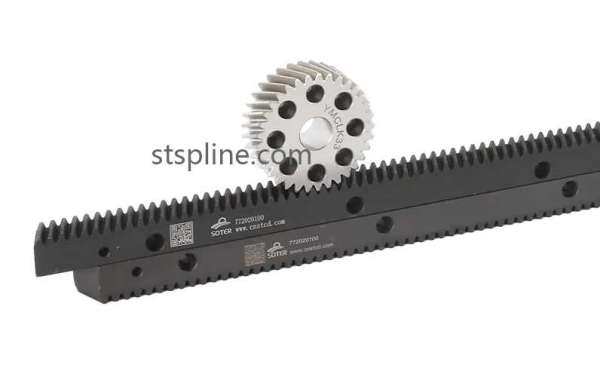
Industrial equipment often needs to move tooling, workpieces, or machine structures along a controlled path. A Rack And Pinion Linear Slide combines a toothed rack, rotating pinion, and guiding structure to convert motor rotation into linear movement. This arrangement can be adapted to different machine layouts, but reliable operation requires careful coordination between the transmission, guide system, supporting frame, and control method.
Material selection is one of the first considerations in the design process. Rack components are often manufactured from suitable steel materials because they provide a balance of strength, machinability, and resistance to repeated contact. The pinion should also be selected as part of the same transmission system. Material compatibility, surface characteristics, and treatment requirements can influence how the two components interact during continuous operation.
The rack and pinion provide the driving force, while the slide structure controls the movement path. The pinion rotates and engages with the teeth of the rack, creating linear displacement along the rack's length. Rails, rollers, or other guide components support the moving assembly and help prevent unwanted lateral movement. Separating the drive and guidance functions allows the system to be designed more effectively.
Tooth geometry has a direct influence on transmission quality. Consistent tooth spacing and accurate profiles help the pinion maintain predictable engagement as the slide travels. Irregular machining can cause changes in contact conditions and may introduce vibration or uneven movement. For this reason, the rack and pinion should be manufactured and evaluated as a matched mechanical pair.
Machining processes such as controlled milling can form the required tooth profile and reference surfaces. The mounting areas are important because they determine the rack's position relative to the guideway and pinion. Even when the tooth profile is accurately produced, incorrect mounting can reduce the quality of engagement. Manufacturing accuracy and installation accuracy must therefore be considered together.
Surface treatment may be used according to the material and working conditions. Heat treatment can improve surface hardness and resistance to repeated contact, while finishing operations may help establish the required surface condition. The selected process should also maintain dimensional stability. Excessive distortion after treatment could affect the relationship between the rack, pinion, and guide structure.
Guideway design is especially important in linear slide applications. The guide system must support the moving load while maintaining the intended travel direction. If the guides are misaligned or the supporting frame is not rigid enough, additional forces may be transferred to the rack and pinion. These forces can influence tooth contact and increase mechanical stress. Coordinated design can help the drive and guide systems work together more consistently.
CNC machines frequently use rack-driven movement in gantry structures and extended travel axes. Similar arrangements may be found in laser processing equipment, industrial robots, automated handling systems, and production-line machinery. The design is useful where a motor-driven mechanism needs to move an assembly over a relatively long distance without relying only on a short linear actuator.
Longer slides may require several rack sections to form a continuous transmission path. The connection between sections should be positioned carefully so that tooth spacing remains consistent. A small mismatch can affect the pinion during transition and may create an irregular movement point. Technical drawings, reference surfaces, and controlled assembly procedures are useful for managing this requirement.
The installation environment should also be considered. Industrial machinery may operate in areas exposed to dust, metal chips, moisture, or other contaminants. Protective structures and suitable maintenance practices can help reduce the impact of these conditions. Cleaning, inspection, and lubrication should be carried out according to the requirements of the complete transmission and guide system.
For equipment manufacturers, supplier selection involves more than checking the basic dimensions of a rack. Engineering support, machining capability, drawing review, inspection procedures, and experience with industrial transmission systems can all affect the success of a project. A supplier that understands the complete slide assembly can provide more useful technical coordination during development and production.
Quality control should cover the rack teeth, pinion interface, mounting surfaces, and overall dimensional consistency. Inspection helps maintain repeatability and supports the use of multiple components in the same machine. It can also help identify deviations before assembly, reducing the risk of adjustment problems during commissioning.
A rack-driven slide is most effective when the transmission and guide structure are treated as one mechanical system. Material selection, tooth geometry, machining, surface treatment, alignment, structural rigidity, and maintenance all contribute to the final movement characteristics. Careful attention to these factors can support stable operation in a wide range of industrial applications.
For manufacturers developing CNC machines, robotic equipment, automated handling systems, and production-line machinery, Rack And Pinion Linear Slide technology offers a practical approach to guided linear movement. SOTER provides rack and transmission products for industrial equipment, with related solutions available at https://www.stspline.com/product/straight-teeth-rack/ .