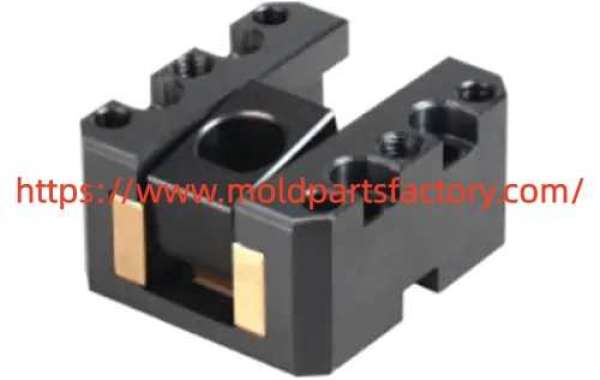
Inclined Ejector Slide selection deserves careful attention when a mold contains undercuts, recessed features, hooks, or other areas that cannot release through a simple opening movement. In Ejector Injection Molding the component must work with the complete tooling structure rather than operate as an isolated part. Buyers should therefore examine geometry, movement direction, available space, material selection, surface condition, installation method, and expected production conditions before confirming a purchase.
The shape of the molded component should be reviewed before any hardware decision is made. An undercut may require angled movement to clear the plastic feature without creating unnecessary stress. The required travel depends on the feature depth, release direction, draft condition, and available clearance inside the mold.
A useful design review should identify where the moving component will contact the plastic part and how much travel is required before release. If the contact point is too close to a thin wall, excessive force may create marks or deformation. A suitable contact area should distribute the ejection load while allowing the finished component to leave the tooling smoothly.
Movement is another important purchasing consideration. The mechanism needs enough room to complete its intended path without contacting nearby plates, pins, inserts, or other moving components. Buyers should review the complete motion sequence instead of checking dimensions individually.
The angle also affects movement. A larger angle can provide more lateral displacement within a shorter vertical stroke, while a smaller angle may provide a different balance between travel and contact conditions. The correct choice depends on the mold structure and the feature being released.
Trial movement during assembly can reveal interference that may not be obvious from a basic dimensional drawing. Manual checking before production can also make later machine adjustments easier.
Tooling components experience repeated movement, contact, and mechanical loading. Material selection should therefore match the expected working conditions. Relevant considerations include hardness, wear resistance, dimensional stability, and compatibility with surrounding components.
Surface treatment can also influence service behavior. Contact areas should be inspected for scratches, uneven finishing, burrs, or other conditions that could interfere with movement. A clean and suitable contact surface helps maintain consistent mechanical action during repeated cycles.
Buyers should also ask about available material specifications and inspection standards. Clear technical documentation makes it easier for mold makers to confirm whether a component fits the intended application.
Maintenance requirements should be considered before installation. Sliding areas need suitable lubrication when the design calls for it, while contamination from plastic residue, dust, or metal particles should be controlled. Poor maintenance can gradually increase resistance and affect movement.
Some designs use self lubricating surfaces to reduce routine lubrication requirements. This can be useful in tooling where access is limited, although the complete maintenance plan should still be reviewed according to operating conditions.
A simple inspection routine can include checking movement, contact surfaces, guide areas, fasteners, and return action. Early attention to unusual resistance or wear can help prevent larger adjustment problems during production.
No single configuration suits every mold. Buyers should provide accurate information about the part geometry, mold dimensions, required travel, installation position, material, and production conditions when requesting a component.
A supplier with manufacturing experience can use these details to review dimensional compatibility and suggest an appropriate configuration. This is especially useful when the tooling contains limited internal space or several moving mechanisms operating close together.
For custom requirements, drawings and samples can help reduce communication errors. Clear information about tolerances and installation conditions also supports smoother assembly and later maintenance.
A good purchasing decision should consider the complete working environment rather than focusing on one specification. Geometry, travel, clearance, material, surface condition, maintenance, installation, and compatibility all contribute to how a mold component performs during repeated operation.
For manufacturers, these details can also influence assembly time and future servicing. A component that matches the actual tooling structure is easier to evaluate, install, inspect, and replace when required.
When buyers compare suppliers, technical communication matters as much as the component itself. Clear drawings, dimensional information, material details, and application support can make the selection process more straightforward. Moldpartsfactory provides mold component solutions for manufacturers that need practical options for different tooling structures. Product information and available component solutions can be reviewed at https://www.moldpartsfactory.com/