Hydraulic Separator Tank selection should be based on the requirements of the complete heating or HVAC installation. Buyers need to consider flow capacity, connection dimensions, material, installation position, internal arrangement, fabrication quality, customization, and production support. For contractors, distributors, importers, and equipment brands, checking these factors before ordering can make supplier comparison easier and help avoid specification changes during later stages of a project.
Start With the System Design
Before selecting a model, buyers should understand the basic structure of the system. The heat source, circulating pumps, secondary circuits, heating zones, and expected flow conditions all influence the required configuration.
A system serving several zones may have different requirements from a smaller installation. Heat pump systems, boiler systems, underfloor heating, and commercial HVAC projects can also involve different design considerations.
Buyers should provide available engineering information to the manufacturer. Flow data, pipe sizes, system drawings, and installation conditions can give the supplier a clearer basis for discussing suitable options.
Confirm Flow Capacity
Flow capacity should be reviewed according to the actual project rather than selected only by product size. Buyers can compare the reference flow range of different models against the requirements provided by the system designer.
The JY-6001 to JY-6005 series from yh-jinyi offers several configurations intended for different system applications. Published specifications include different connection sizes, reference flow values, and volumes. Buyers should still confirm final selection according to their own system design.
For engineering projects, accurate flow information can also help prevent unnecessary changes after the equipment layout has been finalized.
Check Connection Standards
Connection compatibility is another important purchasing point. Buyers should confirm connection size, thread standard, orientation, center distance, and the number of ports required for the planned pipe arrangement.
A product can have suitable flow characteristics but still create installation problems if the connections do not match the surrounding pipework.
For replacement projects, buyers can provide existing pipe dimensions or drawings. For new construction, connection details should be coordinated with the mechanical design before production approval.
Review Material Selection
Material selection should correspond to operating conditions and project requirements. Stainless steel is one option used in this product category, while other materials may be considered according to the intended application and manufacturing plan.
Buyers should request clear information about material grade, wall thickness, welding process, surface finishing, and other fabrication details.
For customized orders, material confirmation should take place before sample development. A change at a later stage can affect production methods, weight, cost, and delivery planning.
Examine Physical Dimensions
Plant-room layout should be considered before ordering. Buyers need to check the available height, width, connection direction, pipe routing, equipment spacing, and maintenance access.
A suitable component should fit into the planned installation area without forcing unnecessary changes to nearby pumps, valves, manifolds, or other equipment.
Providing a dimensional drawing can make this stage easier. Manufacturers can then discuss whether standard dimensions are appropriate or whether a modified configuration should be considered.
Inspect Fabrication Quality
Buyers should inspect the physical construction during sample evaluation. Weld appearance, connection alignment, surface finish, dimensional accuracy, and general workmanship are useful points to review.
For pressure-related equipment, buyers should also ask what inspection procedures are applied during manufacturing and what documentation can be provided for the relevant order.
A clear inspection checklist can help both parties establish expectations before production. This is particularly useful when the product is being purchased for repeated distribution or a large engineering project.
Consider Integrated Functions
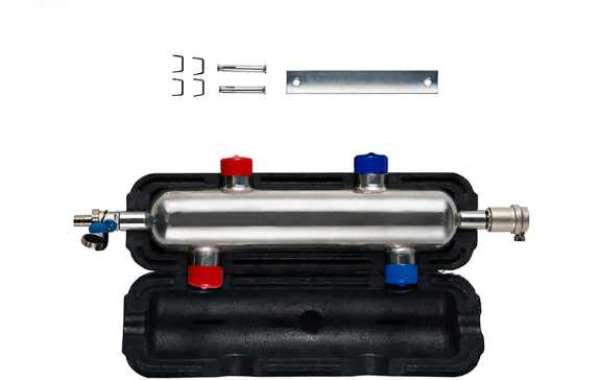
Some models may combine several functions into one unit. For example, the JY-6003 product information lists an air vent, drain valve, mounting bracket, and insulation cover alongside its main body configuration.
Buyers should determine which functions are actually required by the project rather than paying for features that are unnecessary for their application.
The selected configuration should also be reviewed together with the surrounding system components. This can help buyers understand installation requirements and maintenance arrangements before ordering.
Evaluate Customization Capability
Standard products may not satisfy every commercial project. Buyers can ask whether the manufacturer supports changes to dimensions, connection sizes, materials, configurations, surface treatment, or other specifications.
OEM buyers may also require customized labels, packaging, documentation, or branding.
yh-jinyi states that it provides customized design and production services and can develop products according to customer drawings or samples. This can be useful for distributors and engineering buyers working on project-specific requirements.
Ask About Sample Approval
Sample approval is a practical step before larger production. Buyers can use a sample to verify dimensions, connections, material, finishing, accessories, and overall configuration.
Any changes should be recorded clearly after the sample review. The confirmed version can then become a reference for subsequent production.
For OEM projects, buyers should also confirm artwork, labels, packaging, and documentation before giving final approval.
Review Manufacturing Control
A manufacturer should be able to explain how production is organized. Buyers can ask about incoming material inspection, process control, welding procedures, dimensional checks, final inspection, and batch records.
According to yh-jinyi, its manufacturing process includes supplier screening, incoming material testing, production process control, and batch quality monitoring.
For repeat orders, consistent production procedures can make communication easier because the buyer has an established specification and inspection reference.
Consider Order and Packaging Requirements
Commercial buyers should discuss minimum order quantities, production schedules, packaging methods, labeling, and shipment arrangements before confirming an order.
Distributors may need different packing quantities from project contractors. Buyers should therefore communicate their warehouse and transportation requirements early.
Packaging should also protect the finished product during handling and shipping. Carton dimensions, protective materials, and product identification can be discussed during the order-planning stage.
Evaluate Long-Term Supplier Support
A supplier evaluation should include more than the product itself. Buyers can consider technical communication, customization support, sample development, quality management, production capacity, and response to future requirements.
This is especially relevant for distributors that may reorder the same models or gradually expand their product range.
yh-jinyi manufactures decoupling tanks alongside other heating and plumbing hardware, allowing buyers to discuss different product requirements through one manufacturing source.
For buyers comparing manufacturers, a practical checklist should cover system requirements, flow capacity, connections, material, dimensions, fabrication, integrated functions, customization, sample approval, quality control, packaging, and ongoing supplier communication. Reviewing these points before an order is confirmed can make procurement more organized and help buyers match the selected configuration to the actual project. For product specifications, available models, and customized manufacturing options, buyers can visit the https://www.yh-jinyi.com/product/ at and contact the manufacturer according to their project requirements.